
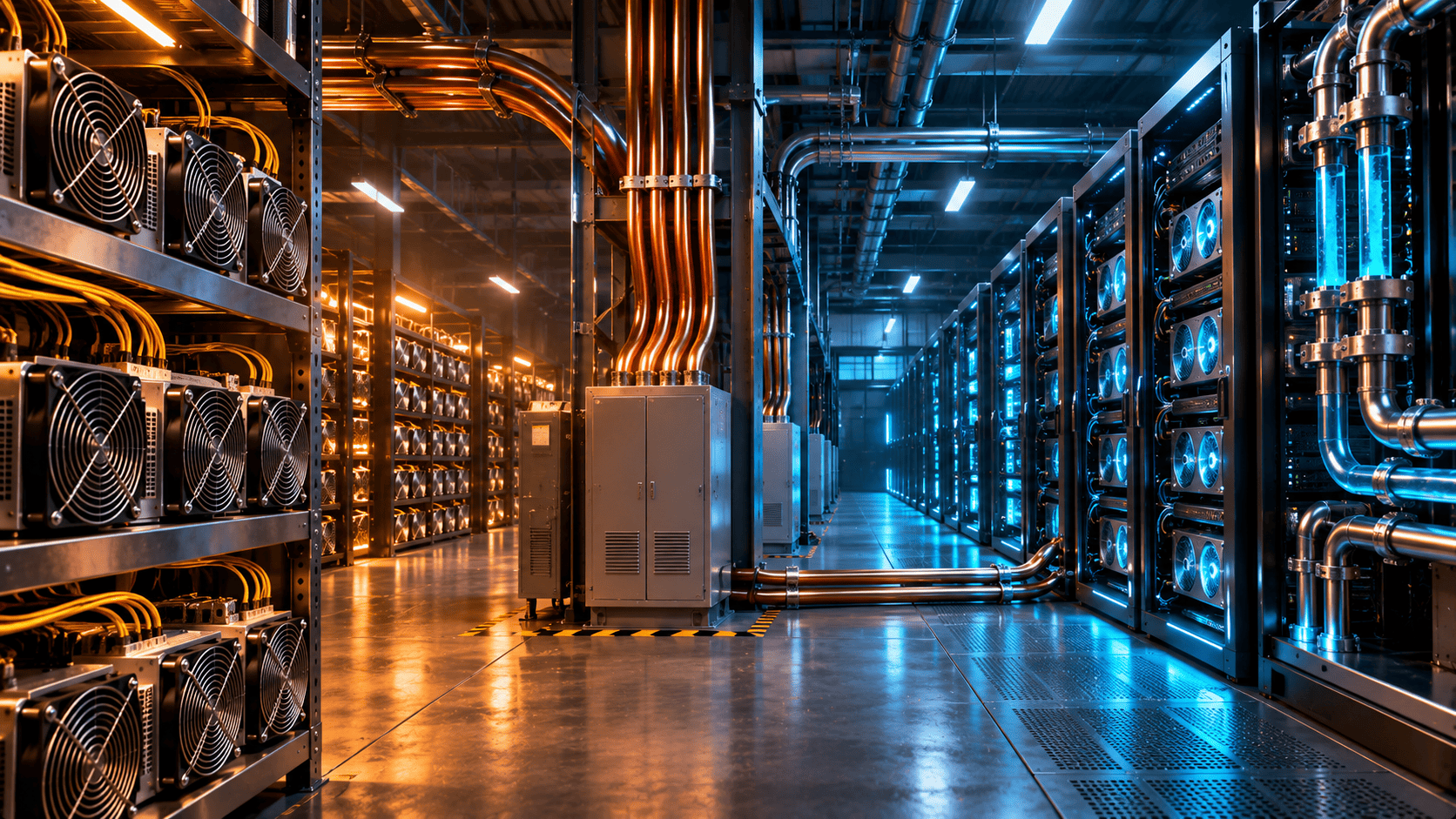
TeraWulf’s digital-asset revenue fell to $13.2 million in the third quarter of 2026 from $43.4 million a year earlier, while revenue from high-performance computing (HPC) leases reached $63.0 million. The figures, reported on November 6 for the quarter ended September 30, illustrate how the former Bitcoin mining-focused operator is shifting its business toward power-backed data centers serving artificial intelligence and other computing workloads.
HPC accounted for about 83% of TeraWulf’s $76.2 million quarterly revenue, versus about 14% a year earlier. However, the earnings announcement also reported an $88.2 million operating loss despite $709.9 million in net income attributable to shareholders. The latter included a substantial noncash accounting gain and should not be read as proof that the company’s new infrastructure business is already consistently profitable. These figures are historical quarterly results, not forecasts for TeraWulf’s stock or Bitcoin’s price.
What Do TeraWulf’s Third-Quarter 2026 Results Show?
The company’s November 6 earnings release and accompanying Form 10-Q establish a sharp change in its revenue mix. The following figures compare the quarters ended September 30, 2026 and September 30, 2025. Dollar amounts are rounded from the reported financial statements.
| Metric | Q3 2026 | Q3 2025 | What changed |
|---|---|---|---|
| Digital-asset revenue | $13.2 million | $43.4 million | Down about 69% |
| HPC lease revenue | $63.0 million | $7.2 million | Up about 774% |
| Total revenue | $76.2 million | $50.6 million | Up about 51% |
| Bitcoin mined | 186 BTC | 377 BTC | Down about 51% |
| Operating loss | $88.2 million | $24.7 million | Loss widened |
The important distinction is that the decline in Bitcoin mining activity did not mean total revenue declined. HPC leasing more than offset the reduction in digital-asset revenue at the sales line. But higher total revenue and a larger operating loss can occur simultaneously when infrastructure investments, operating expenses and other charges rise. Growth in one business line is not itself evidence of positive operating earnings.
Why Did TeraWulf’s Bitcoin Mining Revenue Fall by Almost 69%?
According to the company’s quarterly filing, TeraWulf deliberately curtailed its Bitcoin operations during the first nine months of 2026. Two miner buildings at the Lake Mariner campus were repurposed or taken out of service to support HPC development. Bitcoin production in the third quarter consequently fell to 186 BTC from 377 BTC a year earlier.
The decline also reflected Bitcoin’s average price during the periods reported by TeraWulf. The filing lists an average price of $71,204 per BTC for the third quarter of 2026, compared with $114,390 for the third quarter of 2025. Those are the company’s historical quarterly averages, not live market quotations. Lower production and a lower period-average Bitcoin price both weighed on reported digital-asset revenue.
This distinction matters because a revenue decline caused partly by actively retiring mining capacity carries a different implication from one caused entirely by an unfavorable mining environment. TeraWulf is choosing to allocate more of its electrical and physical infrastructure to contracted HPC hosting. That reduces the weight of Bitcoin mining in its own revenue mix, but it also means future results increasingly depend on delivering data-center space and meeting customer commitments.
It would be inaccurate to say TeraWulf has completely abandoned Bitcoin mining. Its filing and earnings release describe an existing mining operation at Lake Mariner, alongside buildings being converted to support HPC. The numbers document a substantial strategic reduction, not the elimination of digital-asset activities.
Does $63 Million Mean TeraWulf Earned $63 Million in Pure AI Rent?
Not exactly. The $63.0 million figure is the HPC lease-revenue line reported under the company’s financial statements. It incorporates more than the recurring base rent for critical IT capacity. TeraWulf’s third-quarter investor presentation separately identifies about $46.0 million of HPC rent revenue, excluding power pass-through, tenant fit-out and other maintenance-related revenue.
That narrower rent measure represented around 60% of total third-quarter revenue, compared with approximately 83% for the broader $63.0 million HPC lease-revenue line. The presentation says the $46.0 million rent measure rose from $26.9 million in the second quarter, while the broader lease-revenue measure increased from about $31.9 million. The measures should not be interchanged when comparing recurring lease economics with recognized segment revenue.
The economic model is also different from selling AI chips or providing an AI chatbot. TeraWulf develops and operates the power, buildings, cooling and related infrastructure that customers use for high-performance computing. Customer demand for AI workloads supports the leasing opportunity, but the company is not reporting the entire $63.0 million as proceeds from selling its own AI model or directly renting its own GPU fleet.
For readers comparing Bitcoin miners moving into AI infrastructure, this accounting distinction is essential. A larger HPC revenue share may improve visibility through long-term contracts, but it does not remove electricity, construction, financing or tenant concentration risks.
How Did TeraWulf Report $709.9 Million in Net Income With an Operating Loss?
TeraWulf reported about $709.9 million of net income attributable to the company for the quarter. Yet its statement of operations shows an $88.2 million operating loss, compared with a $24.7 million operating loss a year before. These two figures measure different layers of the income statement.
A major contributor to reported net income was a roughly $728.4 million noncash gain from changes in the fair value of warrant and derivative liabilities. The company also recorded an approximately $95.0 million gain on the sale of its Abernathy joint-venture interest. Those items can materially change net earnings without representing recurring operating profit from electricity-intensive data-center leases.
The company reported negative $12.8 million in adjusted EBITDA, a non-GAAP measure that makes specified adjustments to reported net income. Investors should read the company’s reconciliation and the associated definitions rather than assume adjusted EBITDA is interchangeable with operating cash flow, free cash flow or audited operating profit. The earnings release filed with the SEC provides the reported earnings and reconciliation alongside the underlying statements.
This financial picture is more complicated than either a headline about record net income or a headline about losses alone. HPC revenue is rising rapidly, but the reported quarter does not demonstrate a settled, consistently profitable infrastructure operation. Separating operating results from financing and valuation items is particularly important when evaluating a capital-intensive business transition.
How Much AI Data-Center Capacity Is Operating at Lake Mariner?
At September 30, TeraWulf said it had 102 megawatts of revenue-generating critical IT capacity operating at its Lake Mariner campus in New York. Another 336 MW was under construction in two planned buildings, CB-4 and CB-5, representing 168 MW each. These are critical IT capacity figures, not simply a count of Bitcoin mining machines or a guarantee of revenue for future quarters.
Management expected CB-4 to begin phased deliveries and rental commencement in the fourth quarter of 2026. CB-5 was targeted to start phased delivery in early 2027. Those dates were forward-looking expectations reported on November 6; construction, grid connections, customer readiness and other milestones could affect actual timing.
TeraWulf also reiterated previously disclosed cost guidance of about $8 million to $10 million per critical IT MW for WULF Compute development. Such guidance indicates the scale of capital needed before new leased megawatts can produce recurring cash flow. It is a company estimate, not an independently verified final construction cost for every facility.
What makes the Lake Mariner conversion notable is the physical shift in the same power-backed site: part of the infrastructure that supported Bitcoin mining is being adapted to host contracted computing workloads. The migration is measurable in both reduced BTC production and increased operational HPC capacity.
What Do the Anthropic Lease and Google Credit Backstop Actually Cover?
At the Justified Data Campus in Hawesville, Kentucky, TeraWulf has agreed to a 20-year lease with Anthropic covering approximately 401 MW of critical IT capacity. The company describes approximately $19 billion of contracted lease revenue over the initial term. That figure is a long-duration contractual amount, not third-quarter revenue, cash already received or a guarantee that every future payment will be collected.
In a November 4 announcement, TeraWulf said Google had agreed to provide credit support associated with anticipated financing for the Anthropic leases and that Fluor had signed a definitive engineering, procurement and construction agreement for three buildings. The related Form 8-K clarifies that the backstop covers specified obligations under defined conditions, and its effectiveness is linked to the commencement of the relevant leased data halls.
Google is not automatically the tenant of all 401 MW, and a credit backstop is not the same as Google purchasing $19 billion of computing services from TeraWulf. The filing describes contractual options following certain defaults, including assuming a lease or, in specified circumstances, paying a termination fee. The arrangement may improve financing prospects, but its protections have conditions and limits.
The Justified project expects phased ready-for-service delivery from late 2027 through the second quarter of 2028. Those milestones remain development targets. Investors assessing this revenue pipeline must distinguish capacity that is signed, capacity that is being built, capacity that has been delivered and revenue that has actually been recognized.
What Are the Financing and Power Risks Behind the Expansion?
TeraWulf ended September with approximately $2.4 billion in cash, cash equivalents and restricted cash. The inclusion of restricted cash matters: it should not be presented as an unrestricted bank balance available for any purpose. The company’s investor presentation also reported approximately $3.4 billion of net debt using its non-GAAP definition, reflecting the financing obligations tied to its infrastructure ambitions.
Subsequently, TeraWulf increased its revolving credit commitments from $250 million to $400 million, with a potential additional $150 million feature subject to conditions. The company has also used asset sales and project-level financing as part of its capital strategy. These arrangements can support expansion, but financing availability and future cash generation remain separate questions from the headline value of a lease.
At its Muskie campus in Kentucky, TeraWulf said contracted power arrangements had expanded from 500 MW to 1,000 MW, subject to approval by the Kentucky Public Service Commission. This is contracted electrical power capacity; it should not be equated with 1,000 MW of operating, revenue-producing critical IT load. Permitting, transmission work, construction and commissioning still determine when a power agreement can turn into usable computing capacity.
The company’s stated goal of signing 250 MW to 500 MW of additional critical IT capacity annually is likewise a management target, not a completed delivery. These distinctions help explain why an infrastructure business can have substantial future lease commitments while reporting current operating losses and significant financing needs.
What Should Bitcoin Mining and AI Infrastructure Investors Watch Next?
TeraWulf’s shift illustrates a broader commercial question for power-rich Bitcoin mining operators: can existing land, utility access and technical infrastructure generate more predictable returns when redirected toward HPC tenants? The company’s latest financial statements show the change in revenue composition, but do not yet answer every question about long-term margins or shareholder returns.
- Recurring rent versus gross HPC revenue: Track the narrower rent measure as well as power pass-through and service revenue, without treating them as identical cash-flow streams.
- Operating results and cash demands: Monitor operating losses, noncash valuation adjustments, financing costs, capital expenditures and the actual availability of restricted funds.
- Delivered versus contracted capacity: Compare Lake Mariner’s operating megawatts with construction milestones, and distinguish Justified’s future lease commitments from recognized revenue.
- Customer and financing execution: Review the conditions of credit support, construction contracts, power arrangements and any changes to project delivery schedules.
- Remaining Bitcoin exposure: Follow actual BTC production and digital-asset revenue rather than assuming the mining operation has disappeared.
These are business-model considerations, not recommendations to buy or sell WULF shares, Bitcoin or any other asset. Quarterly financial statements are backward-looking; contracts and delivery projections involve risk and may change.
The bottom line: TeraWulf’s November 6 results document a rapid pivot: Bitcoin-related revenue fell by almost 69% year over year, while HPC lease revenue reached $63 million and became the bulk of sales. The transition is already reflected in operational data, but its ultimate profitability is not yet established. A widening operating loss, noncash influences on net income and the cost of bringing contracted data-center megawatts online are as important as the growth headline.